A French bistro now has a new home of its own
How we got Bistrot76 online in under two weeks — then built it into a fast, self-managed site that looks and feels like the place it represents.
Plenty of small restaurants run for years without a real website. They're not ignoring the internet — they're living on it, just in someone else's house. The website is a Facebook page. Bookings come in by phone, WhatsApp, and Messenger. Promotion happens on Facebook and Instagram. It works, right up until it doesn’t: there’s nowhere to point a curious customer that you actually own, nowhere that shows the full picture, and the personality of the place gets flattened into whatever a social feed allows.
Bistrot76 — a French bistro in Tbilisi with a bar, a kitchen, and a small stage for live performance — was in exactly that position. A real, characterful venue with a loyal following whose entire online home was a Facebook page, with bookings and chatter spread across Messenger, WhatsApp, and Instagram. No central home of its own.
We built them one. The first goal was simple: get them a real, owned site online quickly — which we did, in under two weeks. From there we kept building, turning that first site into a fast, self-managed CMS the owners run themselves — and we’re still improving it.
Here’s how it went.
The situation
Bistrot76 had everything that makes a place worth visiting, fun people, a nice vibe but I wanted to help build them a proper online presence. Its existing web presence was a Facebook page. Bookings ran through phone calls, WhatsApp, and Messenger; the marketing ran through Facebook and Instagram. There was no single address on the web that belonged to the restaurant — no place that held an editable menu, the opening hours, the upcoming events, and the story of the place all at once.
That’s a more common starting point than the industry likes to admit, and it has real costs. Social platforms own the audience, not the restaurant. A potential customer who Googles the name lands on scattered third-party listings instead of a page the owners control. And the brand — the specific character of this bistro — never gets to show up at full strength, because it’s squeezed into the same template every other business on the platform uses.
The owners run the place day to day. One comes from the restaurant world, the other from performing arts — which is exactly why the bar / kitchen / stage combination exists. Neither has hours to spare learning a fiddly admin panel or chasing plugin updates. So whatever we built had to do two things at once: give them an owned home on the web, and stay genuinely easy to keep current.
What we found
Two things shaped the build.
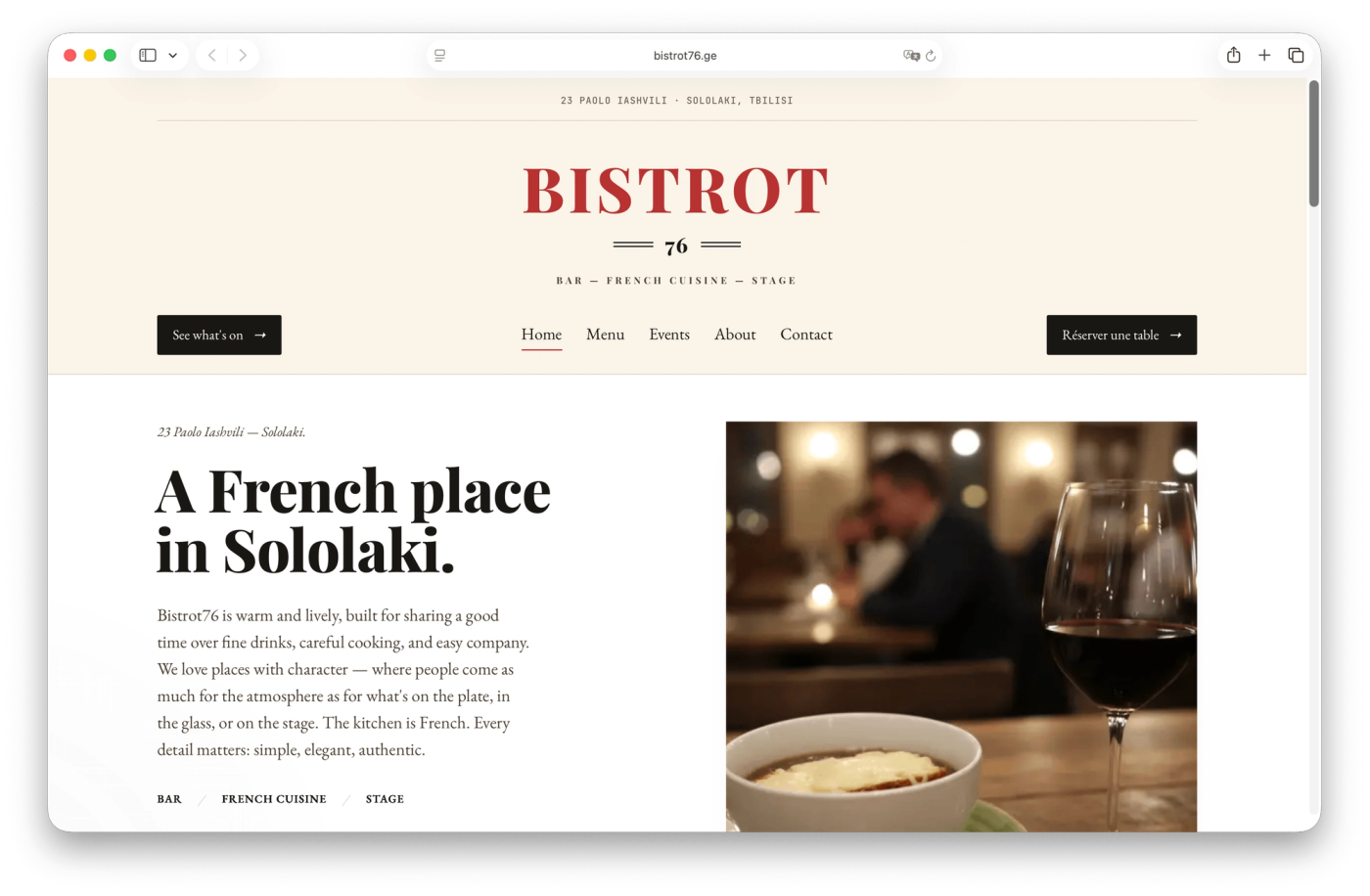
First, this was a brand with a real personality that deserved to be on screen. A bistro that’s also a stage, run by a restaurateur and a performer, is not a generic “restaurant near me.” It has a feel — a tone, a sense of place. The job wasn’t to drop their details into a stock template; it was to design something that matched the look and feel of the venue and the personality of the brand, so the site reads like an extension of walking through the door rather than a directory entry.
Second, the content they needed already existed — it just lived in their feeds and their heads. Menus, dish descriptions, event details, photos: most of it was already out there across their social presence and various listings. Rather than hand the owners a long questionnaire and wait, we gathered what was publicly available, organised it, and turned it into the first draft of the site. The owners then supplied the originals that mattered — the actual menus, the logo, a set of dish and interior photos — and corrected anything off. Their time investment was small; the result was a complete site rather than a half-filled shell.
What we built
The site runs on a modern, headless stack:
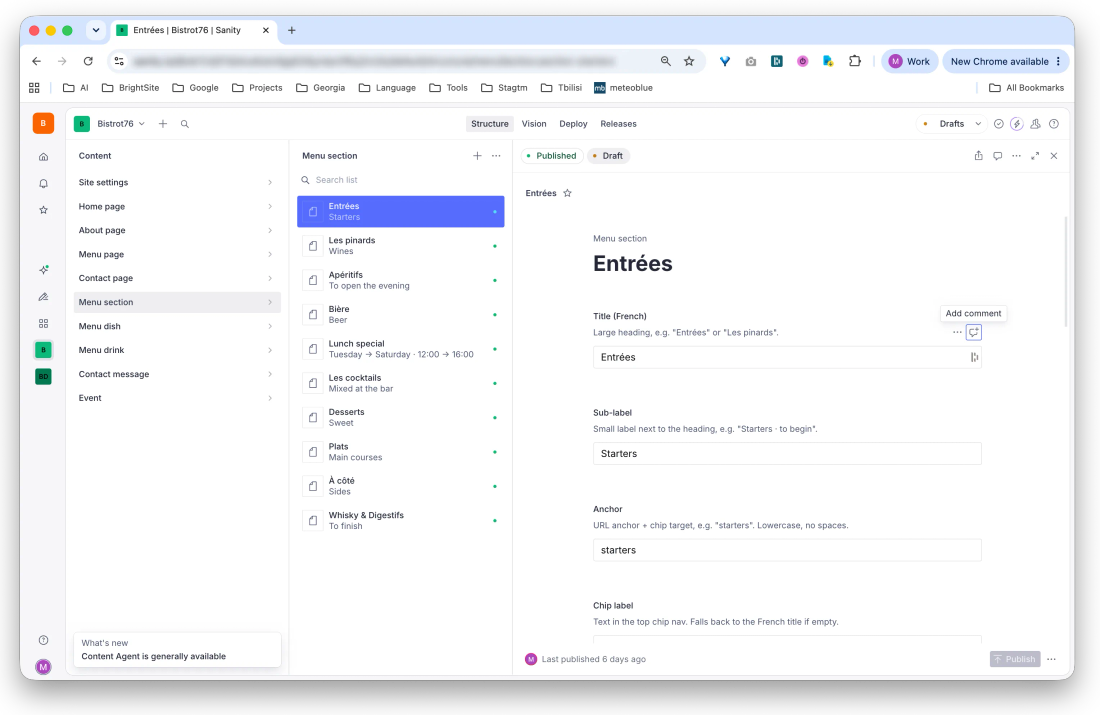
- Sanity as the content layer — where the menu, events, and page copy live. The editing interface is structured and approachable: you change a dish or add an event in clearly labelled fields, not in a wall of formatting controls.
- Astro as the front end — rendering fast, lightweight pages with no heavy framework weighing them down.
- Cloudflare Pages for hosting and delivery — globally fast, secure by default, and effectively free to run at a restaurant’s traffic level.
The practical effect: pages load quickly, there’s no server to maintain, no plugin soup to patch, and the running cost stays close to zero rather than becoming an annual hosting-and-extensions bill. The content is fully portable too — it isn’t trapped in a theme, so the site can be redesigned down the line without starting over.
But the stack is the easy part to talk about. The part that makes this Bistrot76’s site rather than a generic restaurant site is the design. We treated the brand as the brief: the centred wordmark and quiet, confident header; the alternating warm and clean section backgrounds; the type and tone that carry the bistro’s voice; the way French runs naturally through the copy — dish names, section titles — as part of the personality rather than a bolted-on translation. The home page leads with what the place is now: bar, French kitchen, live stage. Events get their own destination instead of being buried, because the cultural programming is part of what makes the venue distinctive. There’s an about page that tells the story, and a contact route wired straight to the owners with spam protection in front of it.
The result is a site that feels like the venue — and when the owners publish a change, it’s live within a couple of minutes. No retainer required to change a price.
The part most builds skip: documentation
A site is only as good as the team’s ability to keep it current. A beautiful build the owners are afraid to touch is a build that goes stale — and a restaurant that’s spent years running on WhatsApp doesn’t need a new dependency, it needs independence.
So alongside the site, we wrote the owners a plain-language guide to running their own content: how to log in, where to change the menu, how to add an event, how to publish. It’s written for people who don’t think about websites for a living — short, specific, jargon-free. The point is ownership in the fullest sense: they own the site, and they own the ability to keep it accurate, without a standing call to us every time the specials change.
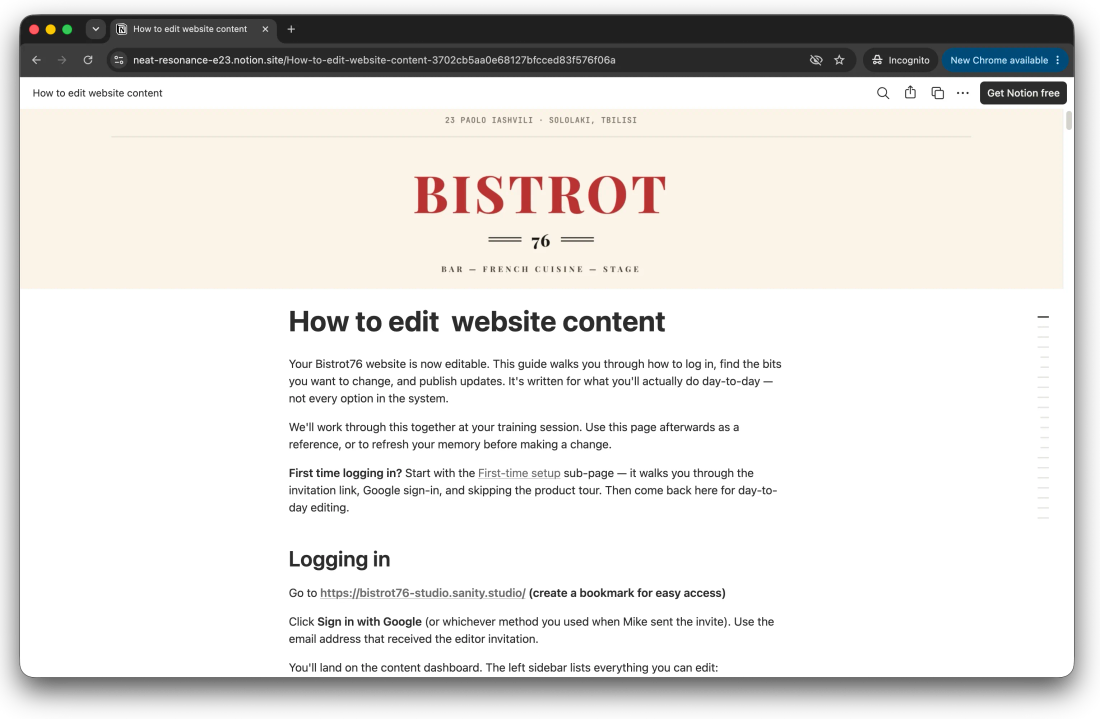
That handoff is the difference between delivering a website and delivering a capability.
What it means for a business like yours
If your whole web presence is a Facebook page and a busy Instagram — and it’s working — none of this is a criticism. It’s an observation: you’re building an audience on land you don’t own, in a template that can’t quite sound like you.
The lesson here isn’t “use this exact stack.” It’s the shape of the decision:
- An owned web home changes your footing. Social platforms are where you meet people; your own site is where you control the story, the brand, and the booking.
- A modern site can be built fast when the content is gathered intelligently instead of extracted from you one form at a time.
- The design is not decoration. A site that actually looks and feels like your business does work a template never will.
- The handoff matters as much as the build. Owning your site means being able to change it yourself.
Bistrot76 went from a Facebook page and a scattering of messaging apps to a fast, characterful, self-managed home of its own — online in under two weeks, then built up into a site the owners run themselves, and still improving — most of it without pulling them off the floor.
That’s the kind of work we like: senior-level delivery, done quickly, designed to fit the business, and handed over properly so the client actually owns what they’ve got.
BrightSite is a one-person digital studio — senior web design, development, and strategy, without the agency overhead or the layers in between. If your business is living on someone else’s platform, that’s the conversation we have. Get in touch.